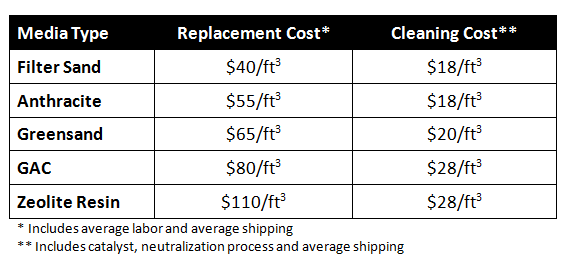
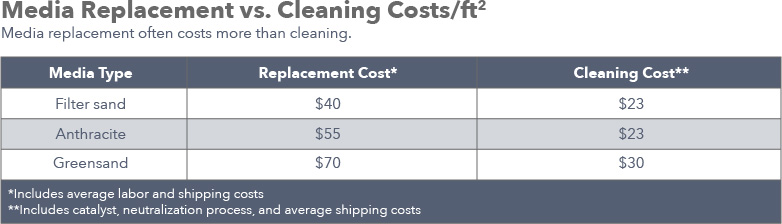
Blue Earth Products’ proprietary media cleaning chemicals and two-step cleaning process provides a significant cost saving advantage over complete media change out. Based on actual cleaning projects, the table below shows a cost comparison of media cleaning and full media change-out. For all media types, cleaning is less than half the cost of replacement.

Our media cleaning products are proven to remove built up scale and deposits from filter media and to restore media particles to their original specifications and performance standards.
Expected benefits of in-place media cleaning include reduced head loss, reduced effluent turbidity, improved media stratification, longer filter run times, improved backwash flow, removal of mudballs and other particulates, prevention and reversal of cementing and extended media life. Moreover, media cleaning is less time consuming and labor intensive than media replacement.
A typical filter cleaning can be completed in less than 24 hours.

Customer Success Story

A 320 square foot dual media filtration system utilizing Wheeler underdrains was cleaned at an average cost of $16,850 per filter. The cost to replace the media was bid at $43,320 per filter unit. Chemical cleaning of their filtration system provided a savings of $26,470 per filter unit. This savings was sufficient enough to allow the system to clean all four filter units in one year while remaining within their yearly maintenance budget.
After cleaning, the system realized a 30% reduction in backwash flushing over the prior year’s operation. Moreover, the cleaning allowed for more flow to be processed per filter unit, improved turbidity removal and increased filter run times. If you would like to get results like these be sure to request a consultation today.

Tanks are a major contributor to disinfection demand due to low turnover and long storage time. Dissolved solids accumulate and drop out of solution, and biofilms form from the organic matter that was not removed from the raw water. These accumulated sediments and biofilms also contribute to the formation of disinfection by-products regulated under the EPA Stage 2 rules. If left unchecked, these deposits can cause under-deposit corrosion, concrete spalling and other costly infrastructure issues. Therefore, proper tank cleanings should be performed on a yearly basis. There are several tank cleaning services available, here is an overview of the most common options.

  • Pressure washing is the predominant method used by many utilities to clean and inspect tanks. Pressure washing can be effective in cleaning surface contaminates and biofilms, but cannot remove scale or the attachment points for new biofilms.  The cost to pressure wash is comparable to the cost of chemically cleaning tanks; however, pressure washing delivers significantly lower quality results. Biofilm and scale growth will reappear and chlorine demand will increase shortly after cleaning.
  • Diving is a popular inspection technique that allows a utility to inspect without removing the tank from service. Services that specialize in this inspection method require significant training and certification, in addition to specialized gear. Inspection costs range from $2,500 and $5,000 depending on tank size. Cleaning is additional based on the amount of silt in the tank. Divers attempt to scrub away biofilms on tank walls, but usually cannot remove scale or calcium buildups.
  • Remote operated vehicles (ROVs) are similar to divers and produce the same low quality results. Costs can range from $22,000 to $26,000 per tank.
  • Sandblasting and resurfacing a tank is a last alternative in cases where corrosion forces a tank to be repaired. This process costs approximately $250 to $290 per square foot and requires high level certified tank contractors. This process is time consuming and labor intensive.
  • Chemical cleaning is a cost-effective option that produces long lasting results and full removal of biolfim, scale and attachment points for new biofilm growth. Utilizing a simple spray-on/rinse-off process, chemical cleaning is just as easy as pressure washing, but provides superior results. Cleaning can typically be completed in a day’s work and the chemicals are safe for most all tank surfaces. Depending on size and location of the tanks, cleaning can be completed for $5,000 to $20,000. Lower surface-borne chlorine demand, better tank inspections and delayed re-formation of deposits are all benefits to chemical cleaning.

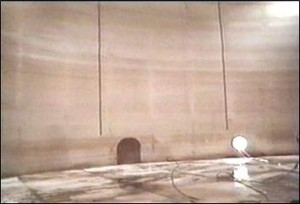
    This image shows a water storage tank after pressure washing. Notice the stains and water lines are still visible.

    This is the same tank after being chemically cleaned. All surface deposits and stains are removed.

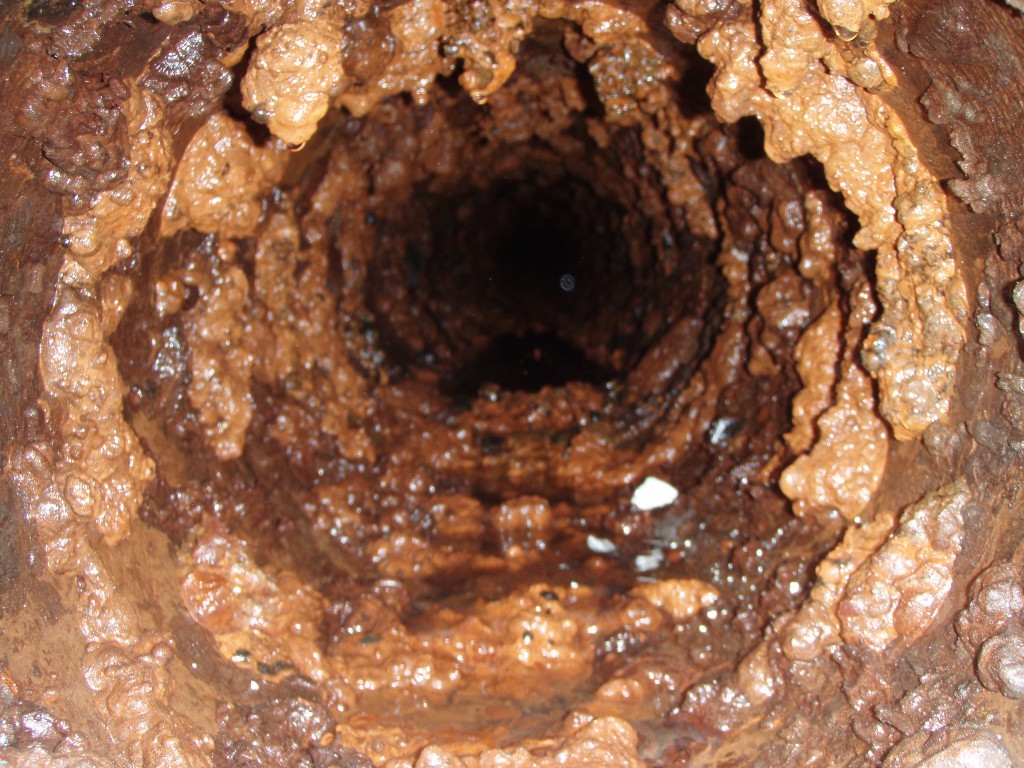
Less than 18 months after the Medicine Park Water Treatment Plant in Lawton, Oklahoma opened, water operators began noticing higher than normal back pressure and shorter filter runs.  Further investigations revealed that the 30-inch effluent pipe, just past the chemical injection point for chlorine, was lined with heavy scale.  Approximately 130 linear feet past the injection point was heavily scaled and the line had closed to a diameter of 18 inches.  Line replacement would be very difficult and expensive due to a section of the scaled pipe being installed under, and penetrating the floor of the concrete water storage tank.

Looking for a solution to remove heavy scale, the plant superintendent contacted Blue Earth Products and inquired about its NSF 60 certified, advanced cleaning and infrastructure maintenance solutions.  Blue Earth Products was able to remove the scale by circulating its Media Master® product through the scaled section of the pipe and allowing it to sit overnight. In the morning, the pipe was flushed and revealed that nearly all the scale was removed and any remaining pieces were loosely lying at the bottom of the pipe.

The cost to replace the 130 linear feet of 30-inch ductile iron pipe was estimated at over two hundred thousand dollars, due to a significant portion of the pipe being installed under and penetrating the floor of the water storage tank. Utilizing chemical cleaning solutions specifically engineered to remove deposits saved the city of Lawton the great majority of the cost of replacement while significantly reducing the labor and downtime needed to fix the scaling pipe.


Drought. It doesn’t just impact the quantity of your supply. Drought seriously impacts the quality of your water source, creating issues that directly impact your productivity.

When the reservoirs and rivers, your vital source waters, drop to below normal ranges, and stay low, it isn’t just the gallons that change. Low levels change the quality of the water, raising the solids and organic loading by limiting the zone from which you can draw water. The clearer zones of a full reservoir are simply not available.

Low source water levels mean shorter filter runs and reduced productivity

All that organic laden silt quickly fills up the media voids, reducing filter runs and requiring more frequent backwashing, slamming your productivity. Worse, even after backwashing, they leave behind organic and inorganic deposits, a biofilm that coats the media, further reducing void space and filter capacity.

These deposits build up on the media, filling the voids and increasing the effective media size. Often accumulating unevenly, the deposits reduce the uniformity of media particles. Perhaps worst of all, these deposits smooth out the angularity of the particles, preventing the full development of turbulent flow needed for optimum filter performance. The net result is further reduction in filter capacity and drastically reduced filtration effectiveness, creating channeling and short-circuiting, degrading the quality of your finished water.

Pressure drops increase and remain higher than normal even after backwashing. Energy costs rise while finished water production declines. And energy and production aren’t the only casualties of the drought – perhaps most important, finished water quality begins to deteriorate.

Processing less water but facing media replacement

In “normal times” you might look at the degradation of the media and decide it was time for media replacement. However, it hasn’t been that long ago that the media was new. It really shouldn’t need to be replaced.

The good news is, it doesn’t!

Blue Earth Products can show you how you can quickly and effectively dissolve these deposits, rinsing them away and restoring the media to like new condition.

Our chemist and engineers have thoroughly studied the chemistry of the filter restoration, understanding the impacts of media type, filter construction, and deposit composition. Our complete suite of patent pending products, combined with our expertise, will guide you through the selection and implementation process to full filter restoration.

Time efficient and thorough – in as little as 24 hours

Blue Earth Lab products don’t just work on the media. They penetrate all the way down through the underdrains, dissolving, cleaning, and restoring from the underdrains up. In as little as 24 hours:

  • Filter media size, uniformity and angularity – restored
  • Void space – restored
  • Underdrain distribution efficiency – restored
  • Filtration capacity – restored
  • Run time – restored
  • Pressure drop – reduced
  • Backwash – reduced
  • Energy costs – reduced
  • Finished water quality – restored
  • Productivity – restored

Restore productivity and improve finished water quality while saving money and time

Media replacement is expensive AND time consuming, frequently taking 5 to 10 days, causing major disruption and increased hassle on your already taxed operations staff.

Cleaning media generally costs a fraction of the cost for media replacement – typically 30% to 50%. More important, because it can take as little as 24 hours, the disruption on your operations is drastically reduced and with minimal additional stress on your staff.

Custom tailored for you – our chemists and engineers work with you on YOUR media, YOUR deposits, YOUR system

With a core sample of your media, our experts will run bench tests to determine the right product, the right dosage and the right procedure to restore your filters to full, like new, capacity. We can assist you in developing a sequencing and remediation plan that will improve your operations in the shortest possible time and with the least disruption.

You can’t control the drought, but you can control your enhance productivity and water quality

During drought, it is even more important that you make every drop count – not only maintaining your productivity but keeping water quality high. You may not be able to recover the productivity lost to the increased solids loading. But don’t you owe it to your customers to reclaim the productivity lost from media degradation while protecting finished water quality? Don’t you owe it to your utility?
Let our dedicated technical team show you how you can restore your productivity, enhance water quality and take back control. Economically, efficiently, quickly.

Save time, save money

You know that sinking feeling. Filter runs are getting shorter and shorter. Backwashing seems uneven, and doesn’t seem to be getting the filters clean. Even immediately after backwashing, headloss remains high and the filter capacity is not what it needs to be. Your productivity is suffering. Your turbidity numbers are higher than you like to see them. The water quality is still acceptable, but not where YOU want it. It’s not what your customers have come to expect.

Grudgingly you look at the calendar and demand records for the last year, hoping to find the next low demand period so you can take the filters out of service and replace the media. You also know it needs to be an extended period as this is affecting ALL your filters, not just one or two. The disruption, as you vacuum out the filter media, try to clean the filter walls, troughs, and underdrains, and then truck in the replacement media, will take well over a week. Then you start making calls to the media suppliers to determine the replacement costs. You contact the landfill to determine the disposal fees. With water demand up, you just don’t know when you will find the right time. You just hope that this whole process doesn’t damage your underdrains.

It’s not the media, it’s the deposits

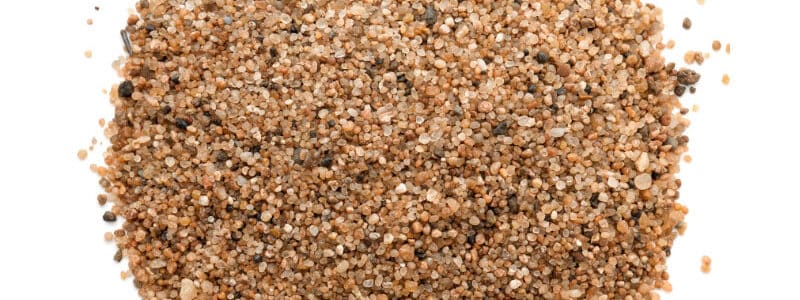
Usually, there is nothing wrong with your media. However, over time, organic and inorganic deposits – biofilms, calcium scale, iron, manganese, algae – coat the media and can’t be removed during the backwash. These deposits alter the media characteristics:

  • Increase the size of the media particles, filling voids, degrading the capacity and altering filtration properties, reducing effectiveness.
  • Reduce the uniformity of the media particles, altering the fluid flow patterns and contributing to channeling and short-circuiting.
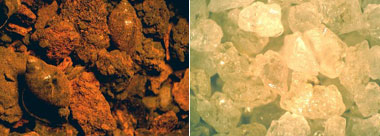
  • Rounds the angularity of the particles, impacting their ability to create the turbulent flow needed for optimum filter performance. This rounding is the most frequently cited reason for media replacement.

Remove these deposits to restore your filter media to its design conditions

Blue Earth Products designed its suite of filter cleaning products specifically to dissolve these deposits, so that they can be rinsed away.

Due to the wide variety of filter media, deposits, and filter construction, media cleaning chemistry also varies. Blue Earth Products understands this chemistry and developed the complete line of patent pending formulas to address these varying requirements.

The chemists and engineers at Blue Earth Products can analyze your filter media, determining the type of deposits and the extent of deposition. They will evaluate your backwash system, and consider the construction of your filter and underdrain system. They will then run bench tests to determine the right product and the right dosage to restore your media.

Blue Earth Products proprietary formulas are suitable for pressure or gravity filters, and on almost all media types including anthracite, sand, green sand, ceramic, GAC and other specialty media.

Restoring capacity, restoring performance, custom tailored to your filter, your media, your deposits.

Clean in place, even the underdrains

Deposits don’t just affect the media, they also coat and clog the underdrains, increasing pressure drop across the drains and impacting filter performance. Replacing the media does not address the underdrains, which require separate cleaning, adding to the time and expense of media replacement. With the complex designs of many underdrains, this method of cleaning is often less than totally effective.

Blue Earth Products filter cleaning products clean in place, penetrating all the media layers down to and through the underdrain caps, into the underdrains. Our products thoroughly remove deposits that reduce production rates, restoring the flow capacity. Backwash distribution begins in the underdrains, so the Blue Earth Products media cleaning process also restores the backwash effectiveness and efficiency from the underdrains up.

Save money, save energy, save water, but more important, save time

In most cases, the cost to clean the filter media is a fraction of the cost to replace – from 30% to 50% less than replacement.

Even more critical are the time savings. Filter cleaning can be done in as little as 24 hours. Compare that to the 5 to 10 days required for media replacement. Filter cleaning gets your filters back in production quicker, producing the quality water that your customers expect.

Filter restoration with Blue Earth Products products is quick and economical, so you can restore your filters sooner in the process, before they approach failure. You save on backwash energy, and improve filter run time and water productivity, saving you even more money.

Safe, sustainable, cost effective, efficient

With just a couple of liters of filter media, and information about your system, the chemists at Blue Earth Lab can custom design just the right filter media cleaning program for your system.

Restoring your filter to design conditions quickly, cost effectively, with less disruption. Doesn’t that sound like a better alternative?

DOWNLOAD TWO-STEP CLEANING
Las Vegas, NV – Blue Earth Products, a leading specialty water chemical research and development company building an innovative chemical platform to solve water infrastructure issues, is pleased to announce today that the Company has earned ISO 9001:2008 certification. To achieve this certification, Smithers Quality Assessments Inc. (SQA), a leading independent, accredited registrar, conducted a comprehensive system audit of Blue Earth Products’ operations to ensure the Company adhered to the industry’s most exacting requirements for quality procedures.

“The ISO 9001 certification process is a challenging endeavor for any organization, and one that requires complete dedication to the pursuit of quality in every aspect of our operations,” said Dane Madsen, CEO of Blue Earth Products. “In achieving this feat, we certified even more, our commitment to excellence and delivering the highest customer satisfaction possible.”

ISO 9001:2008 is a quality management system standard that was developed by the International Organization for Standardization, which is an association of governmental and nongovernmental organizations from many countries. The ISO 9001:2008 standard is utilized to certify quality management systems that focus on continuous improvement, customer satisfaction and the active involvement of both management and employees in a process-based approach.

Watch This Video To See How This Will Affect You

For more information, please contact info@blueearthlabs.com or 1-800-259-4456.

Blue Earth Products, a chemical research and development company, develops advanced cleaning and maintenance solutions to assist commercial facilities in providing safe, clean water. The Company’s NSF 60 certified products are specifically engineered to extend the operational life and efficiency of any water infrastructure by removing organic and inorganic contaminants both online and off line. Founded in 2010, Blue Earth Products combines chemistry with commitment, innovation and expertise to deliver simple, cost-effective water infrastructure solutions to customers across the globe.


Conventional tank and basin cleaning methods such as washouts and power washing do not effectively remove deposits that form on tank walls. These methods are labor intensive and time-consuming and can damage protective coatings. Watch our video below to see how Top Ultra™, our water tank cleaning product, can help remove costly deposit buildup.

Want to learn more about how the drought impacts your water utility? See this additional post: Year Four of the Drought and You are Flushing Lines Again Really?
The Climate Prediction Center at the National Weather Service just released the following images depicting the exceptional and extreme drought conditions for essentially all of California. However, improvement is expected due to the anticipated El Nino weather pattern and what is expected to be a wet year. Even with the increased rain, low reservoir levels may continue.

http://www.cpc.ncep.noaa.gov/products/Drought/