Got heat exchangers? Yep, we can clean those online or off line to improve heat transfer! Find out more on our website.
We’ve Got a Solution For Your Heat Exchangers
There has never been a greater need for cost-effective municipal water treatment than right now. As utilities continue to experience budget cuts / budgetary constraints, they will need to find alternative solutions to improve aging water infrastructure. According to the Reuters article, As U.S. Water Bills Rise, Utilities Struggle For Funds, a new industry survey suggests that “more than 70 percent of water companies either lack the funds to maintain aging infrastructure or have just enough to meet requirements.” Because budgets are tighter, water companies cannot replace pipes and other infrastructure like they have been accustomed to doing in the past. The article goes on to discuss the current surge in asset management as water operators focus on repairing infrastructure instead.
If you are a water operator looking for a cost-effective alternative to water infrastructure replacement, Blue Earth Products’ municipal water treatment solutions can extend your equipment’s life and increase its operating efficiency. Our team can help you optimize your current water infrastructure, so that you don’t have to replace it.
Join at the following events this month….
September 9 – 11
Virginia AWWA Water Jam 2012
Virginia Beach Convention Center
Virginia Beach, VA
Exhibiting & Presenting (“Road to Stage 2 Compliance,” Bob Cashion)
September 14
Azure Water ASHRAE 188 Seminar
Exhibiting & Presenting
September 18 – 21
AWT 2012
Palm Springs, CA
Exhibiting (Booth #620)
September 23 – 26
WaterPro 2012
Nashville, TN
Exhibiting (Booth #517) & Presenting
PROBLEM
In evaporative cooling tower systems, the make-up water can vary widely and is often “scaling” in nature. As the cycles used increase in these systems, the scaling problem is exaggerated and can lead to mineral scale and organic film formation throughout the system.
This scale buildup results in two confounding problems: First, the scale produces thermal barriers in the system, lowering the cooling tower’s overall performance. Over time, the scale can become so bad that portions of the system must be replaced. Secondly, the scale formation provides a breeding ground for bacterial growth, often harboring deadly Legionella which can lead to a host of health and safety issues. Also, organic films can significantly contribute to thermal conductivity loss.
SOLUTION
In conjunction with Puckorius and Associates, Inc. Blue Earth Labs has demonstrated that Clearitas has been effective at removing accumulated scale and preventing further scale buildup from cooling towers throughout the United States. Thus, Clearitas is a powerful cooling tower treatment for controlling bacterial growth.
Two systems were studied: an HVAC cooling tower in a Las Vegas casino was treated, as well as an evaporative condenser (that was scaled to the degree that it was decommissioned) at a food processing facility in Texas.
In both systems, Clearitas dosing was started at a level to aggressively descale the systems quickly (the dosing was adjusted for the first few days to maintain the oxidation-reduction potential (ORP) approximately 500mV above makeup water. Once significant descaling occurred, a maintenance dose was applied (approximately 100mV ORP above makeup water). In both cases, no intentional blow down was performed and all other chemicals were removed during the initial descaling period.
RESULTS
Overall, two very distinct systems were effectively descaled using a two-step Clearitas dosing. The initial high concentration dosing removed large amounts of scale very quickly. This was followed by a maintenance dose that continued to remove small amounts of scale and prevented further scale formation. Clearitas is effective at removing scale if the makeup water has some amount of organic material present, even at trace levels, including bacteria from cooling towers.
PROBLEM
The municipality of Ripley, West Virginia supplies South Jackson County’s water. South Jackson County was encountering problems within the water distribution system, which were aggravated by the long distribution distances and various rates of flow. They looked to Blue Earth Labs to help improve their disinfection by-product (DBP) levels in their water distribution system to remove scale and reduce chlorine demand.
SOLUTION
To treat DBPs within South Jackson County’s water distribution system, Blue Earth Labs fed Clearitas in conjunction with traditional free chlorine. After chemically treating their infrastructure online with Clearitas, South Jackson County conducted a study to determine DBP levels.
During the study, DBPs were measured at six points within the water distribution system. HAA5 levels went down almost immediately at five of the six sites after the addition of Clearitas. THM levels were reduced at four of the six sites but at a much slower rate. In this particular system, the farthest point from the injection site saw little improvement in THM levels, but immediate improvement in HAA5 values. This might suggest that TTHM and HAA5s are formed at different rates and/or locations and that Clearitas either has direct (by interfering with the formation of the components or by destroying them after formation) or indirect (through removal of surface deposits) effects in this particular water distribution system.
RESULTS
Overall, a very low dosing of Clearitas was extremely effective at decreasing the DBPs in the problem portions of South Jackson County’s water distribution system. Scale was removed fairly quickly near the injection point. As scale was removed from the system, Clearitas gradually began cleaning the pipes further out in the distribution system. By removing the organics that react with chlorine, DBPs continued to decrease and chlorine residuals stabilized, improving the overall quality of South Jackson County’s municipal water supply.
PROBLEM
In conjunction with Water Solution Unlimited, Blue Earth Labs was brought into the city of Winslow, Indiana to determine if the addition of Clearitas to the water distribution system could improve disinfection by-product (DBP) levels and eliminate stage 2 compliance issues. Used to remove scale and reduce chlorine demand, Clearitas is a proprietary formulation of oxidized chlorine that is added to drinking water distribution systems. Used in conjunction with existing disinfectants, Clearitas has been shown to effectively lower chlorine demand and improve DBP levels in many municipal settings.
SOLUTION
Clearitas 101 dosing started on August 27, 2008, at a concentration of 20 ppm (of product). After two months, the dosing rate was cut in half (to 10 ppm of product). Additionally, in conjunction with the Clearitas dosing, Winslow lowered their total chlorine dosing from an average of 2.1 ppm to 0.9 ppm.
As can be seen from the data in Figures 1 & 2 (view full case study) significant reductions in both DBPs occurred immediately after the addition of Clearitas and stayed low throughout the course of the study of Winslow’s water distribution system, which lasted through 2009. A 55% reduction in TTHMs occurred as well as an 84% reduction in HAA5 values.
RESULTS
In this particular system, a very low dosing of Clearitas was very effective at decreasing the DBPs in problem portions of the water distribution system. In fact, this particular customer had no stage 2 compliance issues related to DBPs after the addition of Clearitas as part of his water treatment program and reported no adverse side effects throughout this study. Moreover, with supplemental Clearitas added, the customer was able to maintain sufficient chlorine residuals in the system even with the lower chlorine dosing, demonstrating Clearitas is effective for long-term DBP reduction.
PROBLEM
Operated by American Water, the Woodlane Ground Treatment Plant supplies water to the Mt. Holly, New Jersey area. The well water is aerated, settled and then filtered through three pressure vessels containing manganese, greensand/anthracite filter beds to remove excessive manganese. Its filter media had been installed in 1992 and was scheduled for replacement in 2004 due to declining performance. American Water considered using Blue Earth Labs’ Media Master cleaning chemistry as a cost-effective alternative to filter media exchange.
The first step in the cleaning process was to conduct an extensive laboratory analysis of the filter media to determine both the compositions and extent of the contamination. The analysis also determines the optimal dosing required for the cleaning. Media samples from all three pressure filters were tested.
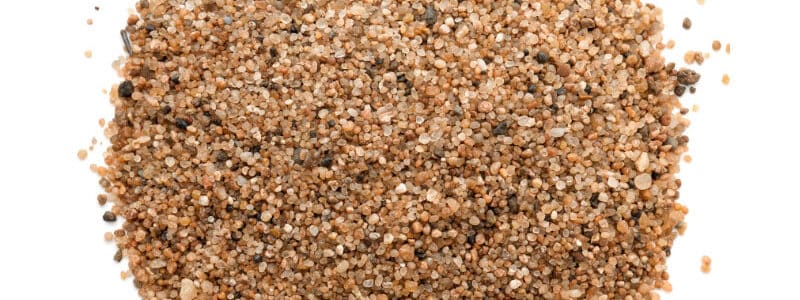
Microscopic analysis showed that the anthracite was completely covered by a black crust and brown, grainy deposits. The original anthracite surface was not visible. Additionally, the samples contained nickel-sized mud balls as well as other solid aggregates.
SOLUTION
Numerous chemical combinations of Media Master and Floran Catalyst® were explored. The most effective combination was a two-step treatment using 8 lbs. of Media Master and 0.7 gallons of Floran Catalyst per square feet of filter media. The treatment protocol resulted in a dry weight loss of 5-7% and released 2,970 mg of manganese and 6,260 mg of iron from each kilogram of media.
The results of the full-scale media treatments were consistent with the laboratory test results. The treatment resulted in the complete restoration of the anthracite and removal of the excessive coating on the greensand.
The cleaning procedure also removed significant manganese sludge from the vessels, which had built up over time and was not removed during backwashing. The manganese concentrations for all three filters dropped from 0.05 ppm before the treatment to 0.01-0.02 ppm after.
RESULTS
Overall, Blue Earth Labs’ Media Master cleaning chemistry effectively returned 13 year-old greensand filters to near new operating conditions. The two-step treatment was less than a third of the cost of media replacement and saved the customer over $100,000. The entire three-filter project was completed in one week and removed approximately 10,000 pounds of contaminants from the filter with no noticeable side effects.
PROBLEM
Since 2005, the community of Sabin, Minnesota, has been a high profile U.S. EPA demonstration plant for arsenic removal. Sabin draws its water from the Buffalo aquifer, as well as two city owned wells. The combined incoming water has traditional arsenic levels at approximately 45 ppb. A new arsenic removal facility built by the city lowers these levels to approximately 10 ppb.
Sabin’s water operator, Rich Hayes, needed a solution to provide long-term system stability to Sabin’s plant. He approached Blue Earth Labs about the addition of Clearitas to his water distribution system to slowly remove built-up iron deposits within the system that had a negative effect on both maintenance and chlorine residuals. However, the EPA had a great concern that the scale removing effects of Clearitas may have the unwanted side effect of increasing the levels of arsenic and other heavy metals in the water by releasing the metals from the built-up scale. The EPA contracted with Batelle scientists to monitor these levels throughout the course of this study.
SOLUTION
Clearitas was dosed into Sabin’s water distribution system at a rate of 2 gallon of Clearitas to 30,000 gallons of water after the arsenic removal plant. After the addition of Clearitas, chlorine residual levels improved significantly as did the turbidity issues after system flushing.
RESULTS
A very low dosing of Clearitas was very effective at improving chlorine residual and turbidity problems throughout the water distribution system. Also, the data provided by Batelle in this study showed that Clearitas did not have a negative effect on the heavy metals within the system, neither from scale removal nor corrosion. In addition, Sabin’s use of Clearitas will provide long-term system stability.