The UK is taking steps toward exposing the issues regarding Legionnaires’ disease while America tries to keep the reality of its dangers from the public eye. The Health and Safety Executive (HSE) contains advice, guidance, news, and publications from Great Britain’s independent regulator for work-related health, safety and illness. Blue Earth Products found an entire FAQ list regarding questions about legionella and its implications on their website. Some questions include “what legionella management systems are available?” and “how can I keep up to date with the progress of this issue?” We hope that one day America will also inform its citizens of the dangers that legionella poses and takes the necessary precautions to tackle this serious and pressing issue. It’s time to take a pre-emptive strike against legionella. Be sure to look at HSE Legionella webpage and some of our products that prevent legionella, such as Clearitas.
While America Denies Legionella, Europe Exposes
What’s Bugging Your Pipes: How Microorganisms Affect Plumbing Systems
This booklet is a resource on microbiologically influenced corrosion as it occurs in plumbing systems of buildings. The book covers understanding, prevention, and remediation of the resultant water quality and pipe integrity problems.
To Plumbing and Building Contractors: There are many new plumbing systems with discolored water, high lead and copper concentrations in the water, holes in copper pipes, and quickly corroding hot water tank anode rods. This mostly occurs from modern plumbing designs that unintentionally promote the growth of microorganisms. This booklet is for you so that these issues will be understood and taken care of properly. Help prevent the future from being filled with ruined plumbing systems, angry property owners and liability lawsuits.
To Municipal Water Utility Managers: The future revision of the Lead and Copper Rule, with a new focus on copper, will probably result in the water utility carrying the blame for the high copper situation in many new plumbing systems. This booklet will explain how you can make sure and document that the municipal water system is not part of the problem. Don’t get blamed for ruined plumbing systems!
“For the second time, the U.S. Patent and Trademark Office has recognized the unique science in Clearitas, furthering our lead in the market.”
-Dane Madsen, CEO of Blue Earth Products
Las Vegas, NV (PRWEB) September 19, 2013- Blue Earth Products (https://blueearthproducts.com), a specialty chemical research and development company that uses chemical innovation to solve water infrastructure issues, today announced that the United States Patent and Trademark Office has awarded U.S. Patent 8,518,270 directed to methods encompassing use of the company’s Clearitas® (formerly RE-Ox®) scale control solution. This patent, the tenth one held or acquired by the company, broadens the exclusive rights obtained by the previously granted U.S. Patent 8,366,939 by covering the supply of an activated scale control solution to a water distribution or water recirculation system without reference to any process for manufacturing the scale control solution.
This patent quantifies the success of Clearitas, the stable product of an advanced electrocatalytic chlor-alkali process designed to attack the organic and inorganic scale that adheres to pipe walls and other wetted surfaces, when applied at low concentrations to remove scale, kill bacteria, reduce chlorine demand and DBPs in both utility and commercial water distribution systems. Additionally, the patent extends Blue Earth Products’ coverage to supplemental mixed oxidants, regardless of manufacturing method, for bulk delivery and injection into previously disinfected water in any water distribution and recirculation systems such as municipal drinking water and cooling towers. It covers dosing a water distribution or water recirculation system with the product to yield supplemental oxidants in a range of 1 to 50 parts per billion – which is equivalent to dosing Clearitas 101 from 2 to 100 ppm as product.
As the only EPA-registered scale control disinfectant, Clearitas possesses unique oxidizing properties that allow for active breakdown of the polysaccharide layer that shields biofilms from traditional disinfectants like chlorine. Clearitas removes the anchor sites for bacteria and prevents future biological growth in the water system with continued use. As a deposit control product, Clearitas provides water system operators with true flexibility – capable of being dosed according to water system needs in order to control the rate of deposit removal while being compatible with all commonly used primary and secondary disinfection methods.
Dane Madsen, CEO of Blue Earth Products, said, “For the second time, the U.S. Patent and Trademark Office has recognized the unique science in Clearitas, furthering our lead in the market. Blue Earth Products will continue to drive strong science, building on the successes to date, expanding our role as a driver of innovation in safe water.”
Recently, the U.S. EPA determined that the disinfectant strength for two product versions of Clearitas – Clearitas 350 and Clearitas 450 – allows them to additionally be used as hard surface disinfectants.
There are currently six Clearitas product versions formulated for utility and commercial water systems including hospitals and healthcare and food processing facilities. For product inquiries, please contact info(at)blueearthlabs(dot)com or 1-800-259-4456.
Clearitas® is a registered trademark of Blue Earth Products, Inc.
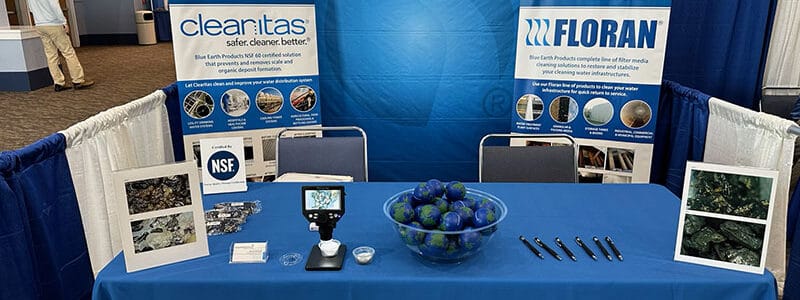
Blue Earth Products® will be at this years ACE Annual Conference on June 9-13 in Denver, CO. Please stop by our booth #14078 to discuss cleaning your infrastructure to improve water quality.

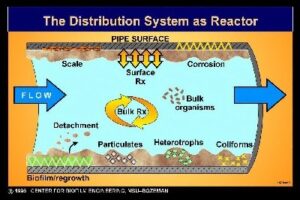
Here’s a great explanation on Biofilm in distribution systems. Let Blue Earth Products® show you how to improve biofilm removal and maintain disinfectant for better overall water quality.
Join Pall Medical in welcoming Janet E. Stout, PhD, a leading expert on Legionelladetection and control, at a webinar to provide education on testing water. Hospital associated infections (HAIs) and outbreaks derived from water outlets have been reported with increasing frequency over the past years. Water distribution systems may represent one of the most overlooked sources for infectious diseases. Learn more about how you can avoid common sampling errors in detecting Legionella and other waterborne pathogens. Dr. Stout will cover best methods, provide practical information, and will discuss the role of testing and monitoring in the proposed ASHRAE Legionella standard.
Recently, I had a conversation with a “water treatment” consultant. He was voicing his opposition to the ASHRAE Standard (see previous post), arguing it was misguiding and self-serving because he believed its primary existence was for adding to one of the committee member’s revenue streams. He went on further, in fact, to quote one of his customers who allegedly stated, “If it were not for ASHRAE 188p, I would not even care about this legionella issue.” This statement is precisely why the Standard must exist. This is why the consultants that support this issue must have an arms-length relationship with the clients. Further, Blue Earth Products has had a “consultant” cause a client to reduce his use of our product Clearitas® 301 “for budgetary reasons.” Instead, the consultant now performs hyper-chlorination for $10,000/month (versus about half that for Clearitas 301 in the same facility). The consultant is not only using a more costly method, he is further damaging the facility’s infrastructure with the excessive use of hyper chlorination (not to mention hyper chlorination is not an effective legionella management tool). What will happen when the facility, in an ill-fated effort to “save money,” actually kills someone? Will this particular consultant be held responsible civilly and criminally? No. Not that they necessarily should not be, but they will not.
So when do we, as a society, start holding people responsible for the damage? When does this become a crime and not just incompetence? Where does the responsibility lay and how far reaching should it go? When I tell outsiders about the Standard, I unfortunately cannot feel comfortable that the Standard will actually solve much. It lays out a well-intentioned process to test for the presence (on a regular basis) in a facility. Then it provides information on what to do when a facility does have a positive test and how to manage the issue so that it does not harm people. The bad news is that the standard cannot regulate people – owners of buildings do not care about the problem, consultants that have a conflict of interest in their “solution, “ and operators that do not test because they do not “want to know.”
This is precisely why the Plaintiffs’ Bar exists – to protect the unwary from the unprincipled.
WaterJAM is Monday, September 09, 2013 @ 8:00AM – Thursday, September 12, 2013 @ 12:00PM and will be hosted by Eddie Abisaab at the Greater Richmond Convention Center. Blue Earth Products® will be providing a technical session on “Filtration Optimization.” Come check us out! For more information visit the Virginia Water Environment Association website here.