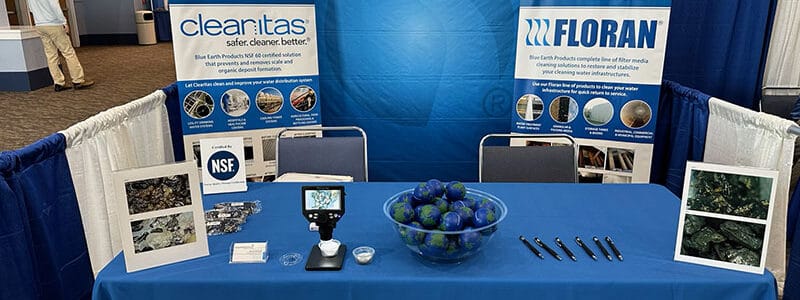
The UK is taking steps toward exposing the issues regarding Legionnaires’ disease while America tries to keep the reality of its dangers from the public eye. The Health and Safety Executive (HSE) contains advice, guidance, news, and publications from Great Britain’s independent regulator for work-related health, safety and illness. Blue Earth Products found an entire FAQ list regarding questions about legionella and its implications on their website. Some questions include “what legionella management systems are available?” and “how can I keep up to date with the progress of this issue?” We hope that one day America will also inform its citizens of the dangers that legionella poses and takes the necessary precautions to tackle this serious and pressing issue. It’s time to take a pre-emptive strike against legionella. Be sure to look at HSE Legionella webpage and some of our products that prevent legionella, such as Clearitas.
While America Denies Legionella, Europe Exposes

Are legionella surviving high levels of chlorine because they are hiding in amoeba?
Norwegian scientists are providing evidence that legionella can survive treatments by hiding in amoeba. As the number of legionella cases have increased in Europe, a mystery has been building up; in spite of high doses of chlorine and hot-water treatments the feared bacteria has continuously been showing up in ships and buildings all over the world.
For the past few years SINTEF scientist Catrine Ahlen has been collaborating with the Royal Norwegian Navy to study how legionella problems arise and remain in ships’ water systems. In the samples they collected, Ahlen found that the legionella had survived the recommended treatment by using amoebae as a shield. She now strongly recommends that contingency planning for legionella outbreaks should be extended to include the elimination of amoebae as well.
Having legionella issues in your water system? Download the case study below to find out how to prevent further legionella infection in your facility.
Photo credit: Pulmonary Pathology / Foter / CC BY-SA
America is caught in a rut. Why? The American Society of Civil Engineers has recently graded our nation’s drinking water infrastructure a “D.” This means more than $1 trillion is needed to replace water pipes in the next couple of decades. This rising debt isn’t only limited to poorly managed utilities but also includes many well-ran facilities where water managers are operating in an old framework that needs to be updated. We are stuck in a recurring cycle of debt and rate increases as conditions continue to deteriorate. This is where Blue Earth Products comes in.
The age of our water infrastructure continues to pose challenge: the high cost to replace water structures are continuing to climb. Blue Earth Products exists to provide safe and cost-efficient products to improve water systems. Water managers around the nation need to act fast before the costs go up more and more.
To read more about rising water rates and utility debt, click here.
What’s Bugging Your Pipes: How Microorganisms Affect Plumbing Systems
This booklet is a resource on microbiologically influenced corrosion as it occurs in plumbing systems of buildings. The book covers understanding, prevention, and remediation of the resultant water quality and pipe integrity problems.
To Plumbing and Building Contractors: There are many new plumbing systems with discolored water, high lead and copper concentrations in the water, holes in copper pipes, and quickly corroding hot water tank anode rods. This mostly occurs from modern plumbing designs that unintentionally promote the growth of microorganisms. This booklet is for you so that these issues will be understood and taken care of properly. Help prevent the future from being filled with ruined plumbing systems, angry property owners and liability lawsuits.
To Municipal Water Utility Managers: The future revision of the Lead and Copper Rule, with a new focus on copper, will probably result in the water utility carrying the blame for the high copper situation in many new plumbing systems. This booklet will explain how you can make sure and document that the municipal water system is not part of the problem. Don’t get blamed for ruined plumbing systems!
Did you know that perfectly safe water contains millions of non-pathogenic microbes in every glassful of tap water? The same is just as true of bottled water.
In the last century the construction of sanitary water delivery systems has ended diseases such as typhoid and cholera that put the public in danger. Although water safety has vastly improved, drinking water is still occasionally contaminated with waterborne illnesses and pathogens. The American Academy of Microbiology in April, 2012, assembled a colloquium to assess what is known about the microbial inhabitants of the water distribution system and to propose goals for advancing understanding of these communities in order to enhance the safety of our drinking water and the resilience of our water structure.
Another Legionella case was found at a hospital in Kent, Rhode Island this May.
NBC covered the story saying, “An elderly woman who died at Kent Hospital in Warwick tested positive for Legionnaires’ disease, a condition she acquired at the hospital.
The woman died in May. Her name was not released.
The hospital said the woman had other health problems too, and the cause of death was not specific to Legionnaires’ disease.
‘Legionella is a germ found in water. It’s found in water that’s warm and stagnant. Things that kill it are heating it and adding chlorine and other chemicals that will get rid of legionella. Hospitals are at risk for legionella because our water supply can only be heated to 120 degrees for patient safety purposes,’ said Dr. David Lowe, an infectious disease specialist at Kent Hospital.
The hospital informed the Rhode Island Department of Health in May and worked with officials to monitor and take measures to identify the source and fix the problem.
‘The systems were reviewed properly. All of the tests were monitored. The tests were and continued to be reviewed and then, when needed, stepping up the level of investigation to levels that you maybe only find in certain critical care facilities in those that deal with immuno-compromised transplants,’ said Jim Beardsworth, a spokesman for Kent Hospital.
Officials found four of 24 ice machines at the hospital tested positive for legionella. But Beardsworth says there’s no definative link between the positive test and the hospital’s patient.
‘Stagnant water. They weren’t being used enough. We found a defect in the machine itself. In the machine, there’s a tube. They removed the tube and it grew legionella. And we’ve removed all the tubes from the machines. Counts from the machines are now zero,’ Lowe said.
In any given year, there are between 20 and 40 cases of Legionnaires’ disease in Rhode Island. So far there have been 32 cases this year.”
Read the story at NBC 10.
According to 10TV:
“The number of cases of Legionnaires’ disease at a Reynoldsburg retirement home has reached 32. A statement from the company that operates the Wesley Ridge Retirement Community said the age range of the cases is from 63-years-old to 99-years-old. Two of the cases were fatal. Preliminary test results indicated that the legionella was in the Wesley Ridge water system. More tests are being completed. Since the outbreak, Wesley Ridge officials have said they have been superheating the water tanks and flushing them with chlorine to kill any bacteria.”
Blue Earth Products ® thinks this story alone demonstrates that long-term care facilities need to properly clean and maintain their water systems to prevent a massive Legionnaires outbreak like this. Legionella prevention using Clearitas 301 has been proven to reduce bacteria counts and improve chlorine residuals in hospitals and healthcare facilities.
A recent water scare in Washington D.C. has highlighted a number of aging infrastructure issues, bringing monetary and physical worries to the public eye. Seeing that most pipelines were laid during the 1940’s-1960’s, many storage tanks and distribution systems are showing signs of needing replacement. Thousands of residents and businesses have been left without water during the hottest time of the year. According to engineers, significant infrastructure investment is needed. The EPA has estimated that $384 billion will be needed to upgrade 73,000 water systems in the next two decades.
We believe that Blue Earth Products® advanced cleaning and water infrastructure maintenance solutions can assist the replenishment of many municipal and commercial facilities across the country. Blue Earth Products is committed to providing safer and cleaner water, which would come at a significantly lower price than that of which the EPA has estimated.
To read more about the water scare near Washington D.C. that sparked infrastructure issues, read the article HERE at USA Today.